
Beauty and Detail

I’ve just returned from my trip to Las Vegas, and I was struck by the level of beauty and detail in each of the many hotels and shows! I’d say Vegas has one of the most successful marketing strategies in the world, and I’m going to give you a look at my trip over the next few posts.

I’m starting out with my surprise at the beauty and detail shown in the hotels. I’ve been to Trevi Fountain and the Arc de Triumph, and the Vegas replicas rival the real thing to a T. Further, the painting on the ceilings, marble-like statues, and gilt columns really give the tourist a sense of the old cathedrals and museums on the other side of the world. It’s amazing what we can do with technology today. You can literally walk down a street and see Italy, France, and New York in an hour!

As a marketer, giving people the “real thing” is a cornerstone for many campaigns… it’s one of Coke’s taglines! People return to Vegas again and again to try to find the new details that they missed on countless other trips. Many car companies, clothing retailers, and restaurants sell entire concepts and product lines based solely on their ability to provide beauty and detail to their customers.

In addition to the beauty in the hotels, many of the tradeshow booths featured gorgeous art and sleek marketing collateral. Aviation is often perceived as boring, technical, and ugly, which many companies proved wrong at the show. You can find artistic shots of engines, wings, and aircraft parts, all woven perfectly with the company tagline and benefits. I’ve been inspired to work on a new booth for one of our companies, insisting that there’s no reason to do things the ugly way when a beautiful way exists! Artistic shots of the details of an engine draw attendees in, and can make the difference between an empty booth and a busy booth.

Once again, I saw how beauty and detail bring people in by the thousands, literally! Part of the Vegas appeal is the ability to experience so many forms of beauty and detail in one small space. The desire for beauty extends beyond our entertainment, and straight into the corporate world, as the booths and marketing pieces demonstrate. Have you ever longed for a car just because it’s a work of art? Purchased a pair of shoes because they looked beautiful in the window? Marveled at the presentation of your food at an expensive steakhouse?
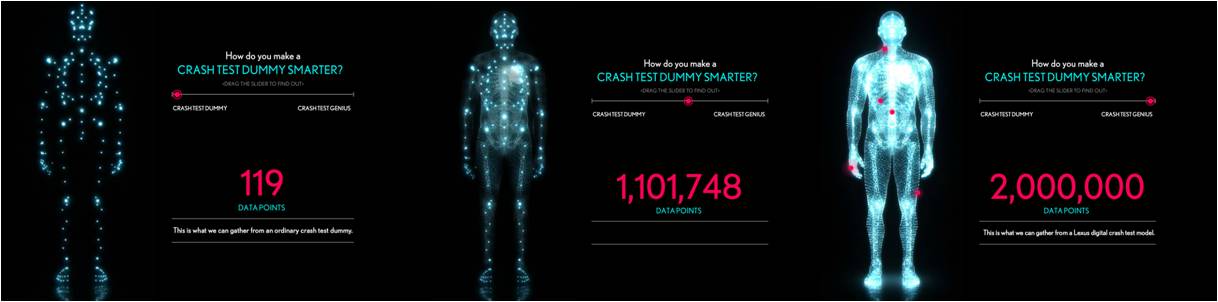
More Lexus Genius

Cool tool on their website shows the progression of data points.


Good ‘ole Lexus, their marketing makes me happy once again! I’ve seen their latest commercial about their superior crash test dummy, and I think it’s a great strategy.

First, they’re reenforcing the message that they are superior to their competitors. Not only do they use superior designs, they use superior testing methods. Since their tests give them more information, they can further improve their design. By highlighting the differences in the testing dummies, Lexus makes the customer question the founding assumptions made by competitors. How do you know that your car’s design can really handle that crash? If you’ve got a Lexus, you know that the superior testing practices have proven that your car is safe.

Second, Lexus shows that they pay attention to ALL the details, not just the look or luxurious feel of the car. Many of their competitors focus on a single feature, like safety or reliability, but Lexus’ new commercial shows that they’re focusing on all your driving needs. Each of their marketing campaigns show an increased attention to detail on a specific feature. The first campaign I mentioned, showcased Lexus’ acknowledgement of the need for convenience, with a secondary nod to the aspirational quality of their product.  Many of their billboards highlight the beauty of the design, with artistic shots of the car on a simple black background… it’s just gorgeous! This campaign shows their commitment to providing the highest quality in safety, and showcases their engineering prowess.

Finally, they follow it up with a great website. Their Engineering Amazing portal takes you to interactive tools, and shows you the science behind their superior crash test dummy.They engage the user on the site, and back up the claims in their commercials with data. It showcases not only the beauty in the design of the cars, but the beauty and precision in the design of everything Lexus touches, which instills more confidence in the customer that they’ve made the right choice in buying a Lexus.

Once again, Lexus delivers a knock-out campaign. Every interaction is professional, with a pin-pointed message to target their customer’s every need.

Groupings

Almost immediately after yesterday’s venting post, I noticed an interesting idea (well, maybe just to the marketing nerds!). Sometimes you just need to let the stress out and things will come to you! Anyways, my inspiration came in the form of trying to hang pictures around the office. I’ve got three photos of engines in one company’s product line, and I wanted to hang them together in a group. Here’s my version of the arrangement:

Arranged by color: silver, blue, silver

I tend to notice colors and crops first, so my initial grouping placed the photos with the “odd” color in the middle, just to keep things even.

My boss, and industry veteran, suggested this arrangement:

Arranged from largest engine type to smallest engine type

He felt that the engines should be arranged from the largest engine type to the smallest engine type. Based on his experience and viewing of photos from aviation, planes, engines, and parts were always arranged either smallest to largest, or largest to smallest. There was some order to the arrangement based on hard data, not color or crop.

And finally, another colleague suggested this arrangement:

Arranged with engine fans framing the non-fan engines

Her assessment was based on factors similar to mine, thinking that you should have the two engines that look like fans on either side of the engine that does not look like a fan. Again, she was going with symmetry that made sense to her mind as her eye saw it.

So how does this relate to marketing? The first application that comes to mind, is grouping things together in a grocery store. Cross-selling is a basic concept in marketing that basically says you should put complementary products together to increase the sales of both items. For example, putting salsa in the same aisle as the chips makes sense, because people eat chips and salsa together. However, salsa could also be placed in the hispanic foods aisle, the condiments aisle, or the sauces/gravy/mixes/marinades aisle. Groupings are an integral part of a store planner’s job, and as my picture example shows, people often group things differently. What happens if I associate salsa with chips, but your brand of salsa isn’t on the chip aisle? If I’m only looking for salsa as grouped with chips, you lose out on me even looking for your product!

Groupings are extremely important in marketing, and how your customer makes connections to your product can make or break the sale. Are they looking at color, hard data, or pictures to determine which things “go together”? Have I missed any other groupings of my pictures?

Marketing Hype? Lessons From the Trail, Part 1

My husband and I enjoyed a backpacking trip over Labor Day weekend on the Lone Star Hiking Trail. Even in the middle of the woods, I couldn’t help thinking about marketing and the corporate world! So, I’ve got a quick 3-part series of posts with some of my thoughts from the backpacking trip.


From the source...


Straight to Your Bottle!

When trekking through the woods for a few days, you either pack all your water, or find water sources along the trail. The water sources along the trail need to be purified, so we used chlorine drops to make the trail water safe. It struck me that most bottled water companies advertise their bottled water as some variation of the message “pure, straight from the source.” There’s usually a picture of a rushing stream, or a lake surrounded by mountains. They sell this water at a premium, and people swear that “pure stream water” tastes much better than “fresh mountain water”. But here I am, LITERALLY getting water directly from the source, and I can’t sell it at a premium… in fact, it’s basically free (I suppose we can count the pennies worth of drops used to purify the water in the cost, but that’s trivial). I think most people would agree that my drops-induced creek water tastes a little funny, and isn’t worth paying top dollar.

On the flip side, if you’re without water in a desert, you’ll pay top dollar for ANY water, not just the fresh, purified stream water. At the point of dehydration, you might not even care if the water is purified at all, figuring a stomach ache is worth the risk to avoid the possibly fatal effects of going for days without water. We weren’t in dire need of water, but we were glad to find this little creek on our route. This creek water was much more satisfying than the lake water (confession: I couldn’t drink the lake water… it was just too gross-looking!).

Thus, my water in the woods is ironically not a “premium” product, even though it lives up to the “straight from the source” marketing, but it would become a premium product if it were more scarce. This was a fun realization in nature, and I look forward to sharing my other insights from the weekend!

JC Penney Debacle

"I'm too pretty to do homework, so my brother has to do it for me."


For those who haven’t seen this story making the rounds on the internet, JC Penney caused a social media storm with a shirt for girls age 7-16 that reads, “I’m too pretty to do homework, so my brother has to do it for me.” Within hours, Tweets and Facebook posts condemning the shirt hit JC Penney, and they pulled the shirt from their inventory on their website. I’ve also seen some defense for the shirt on the Facebook comments to the tone of, “It’s just a shirt people, get over it! We’ve got bigger problems in society!” Obviously, this is causing some controversy and damage control, so let’s take a look at the good, the bad, and the ugly, shall we?

The Good

JC Penney’s response time was immediate, and they decisive action by pulling the inventory from the site. They recognized that they’d angered a lot of their customers, and took steps to immediately rectify the problem. This speed shows that they’re paying attention to their customers, and keeping up with the buzz about their brand. They’ve also come out with statements apologizing to their customers, and detailing how they plan to keep this from happening again. In all, I think JC Penney has done a great job responding to the public’s opinion.


The Bad

While JC Penney appears to be in touch with customers now, it seems they were way out of touch with customers when the shirt was printed and placed online for sale. They wouldn’t be doing damage control in the first place if they’d assessed their values and customer base prior to putting the shirt online. Their head of communications commented that she didn’t know how this happened, which means there’s some serious issues in their communications channels. They’ve also wasted time and money to bring this product to market, and now they must scrap all that inventory. Their time and money would’ve been better spent holding a focus group or developing other ideas to replace the message on this shirt.


The Ugly

This shirt sends a pretty controversial message to most people who read it. The sentiment that pretty girls don’t do homework, or that a boy needs to do a girl’s homework, tends to feed into the already overwhelming messages of body image, gender roles, and capabilities. Several Facebook commenters write that there are already too few women in STEM careers, and telling them from a young age that “pretty” and “homework” don’t mix will further alienate the “smart” girls. By suggesting that boys do their homework, some commenters state that it furthers the feeling that girls are not as smart as boys. In short, this message coincides with a lot of negative messaging, and JC Penney should think twice about promoting a message that could be considered offensive. Whether they meant to be cute or funny, the message was sure to hit a sour note among consumers.

Time will tell whether JC Penney will face more than just verbal consequences for this misstep, but I think they’re handling the response well. Hopefully next time they’ll spend more time on preventative measures, to produce a product that resonates with their consumers and their brand values. With the speed of communication and the widespread use of social media, companies need to be much more diligent when considering controversial messages on their products.

What’s in a Name?


Excedrin Migraine


Excedrin Extra Strength

Images via Excedrin website


On a recent trip to Wal-Mart, I noticed that Excedrin sells an “Extra Strength” capsule, and a “Migraine” capsule. As a migraine sufferer, I was interested to know the difference between the two. Turns out, the only difference is the packaging! The price is the same, the ingredients are the same, and the amount of active ingredients are the same. The products are identical, with the exception of the name on the front of the package. I thought this was odd, but on further reflection, I’ve come up with a few reasons it might make sense.

Superiority complex. As a migraine sufferer, I know the difference between a little ‘ole headache and a full-blown migraine, and there’s no convincing me that a regular pain killer is going to have any effect on my migraines. Thus, when I need migraine medicine, I need MIGRAINE medicine. During my last migraine, I didn’t have prescription pills on-hand, so I told my husband to go to the store and pick-up something specifically for migraines. This means I don’t want “extra strength”, I don’t want “headache”, and I don’t want “generic pain killer”…. I want “migraine”. So, if Excedrin has a pill that specifically says, “migraine”, it will win out over Tylenol’s “extra strength” or Bayer’s aspirin. The reality is that the active ingredients and doses are identical, but something about seeing the name “migraine” tells me that this pill is superior because my migraines are more intense than a headache.

Proxy for efficiency. Most pain meds will put a picture and a small description to help the afflicted quickly determine whether the pill is right for their needs. There’s pills for back and neck pain, headaches, muscle cramps, and any other variety of physical ailment. If you read the labels, most pills use exactly the same ingredients and doses. However, when you’re in pain, you want to make your decision about which brand to buy as quickly as possible. The names on the packages act as a proxy for efficiency, allowing you to grab “back and neck pain” instead of figuring out whether the generic pain med is applicable to your situation.

Perception of variety. By using different names on the packages, brands give the illusion of variety of choice. Thus, when you feel like you need a specific type of pill for a specific type of pain, you feel comfortable choosing a box from a brand that meets your need specifically. If I’ve got a migraine, I can use Excedrin migraine. If I’ve got a “bad” headache, I can use Excedrin extra strength. If I’ve got a “regular” headache, I can use the standard Excedrin. The doses may vary slightly between “regular’ and “extra strength”, but I’m more inclined to buy one of each type to have on-hand when my specific need arises. This perception of variety makes me buy “different” products to meet my needs, and keeps me coming back because I feel like the brand has exactly the right pill for me.

With identical prices, it makes sense for Excedrin to put different names on their products, even though the active ingredients and doses are identical. This variety helps the customer feel like their specific need is met, instead of lumping all pain-related issues into one category. Sometimes I wonder if the placebo effect comes into play, as I feel much more relieved to take “migraine” medicine vs. “regular” headache medicine. It seems like Excedrin came up with a pretty good strategy for selling more pain meds!

Package Alterations

Oreo Package Instructions

While opening a package of Oreos the other day, I came across their explicit instructions, “Open With Pull Tab on Top!” It made me wonder how the company came to the decision to change the packaging.

The Impetus. First, I have to wonder what initially prompted them to consider swapping the traditional tear-open side for the pull-tab top. I assume there was some customer feedback indicating that the traditional opening method was frustrating. But how did they collect that? Did they conduct a focus group to ask, “How could we improve the Oreo experience?”, and several panelists suggested altering the package? Maybe they used survey, with specific questions about the Oreo packaging. Or, maybe they used observation in their daily lives, noticing that every time they had to open and close a package of Oreos, they were annoyed with the process. Whatever, the discovery, I think packaging is a natural place to look for updates if the product is relatively successful. Oreo has made some product changes by introducing Double Stuff and other creme flavors, but there’s little room for improvement on the product itself. Thus, the Oreo experience might be improved by making the package easier to open and close.

The Convincing. After making the discovery that the packaging should be changed, I have to wonder how the marketing or design genius convinced Oreo to invest in the new packaging. The company would have to tweak their machines, inks, and presses, to accommodate the new design, so there was definitely some money involved in making the update. Maybe they used one of the focus groups or survey data to show that customers would enjoy the Oreo experience more. Maybe they made a prototype and let the decision-makers try it out for themselves. Somehow, the responsible parties had to make the case that this change was necessary and beneficial for growth.

The Impact. After making the discovery and convincing the bosses to make the change, I’m wondering how they’re measuring the impact to show that the alterations have added value. Are they just measuring sales and volume growth? Did they repeat the surveys and focus groups? Marketers usually have a hard time measuring their impact, since there are so many different variables. I don’t recall a new campaign to praise the new packaging, but a lot of products run new commercials or ads when they alter the packaging. Thus, it begs the question: was it the packaging that increased sales, or the new ad campaign that increased sales? The timing of the release can also have an impact, so it’s hard to give numbers on the actual impact of just the packaging alteration. How do they know that the time and money spent to research, develop, and launch the new packaging was worth it?

I’d love to be a fly on the wall during Oreo’s decision to make this packaging update. I think there are a lot of elements involved in creating a superior Oreos experience, and I find the steps to tweaking these elements to be fascinating. Am I the only Marketing nerd who thinks this would be a fun case study? 🙂

Running in the Background

When you’re passionate about a subject, you’ve always got topics related to that subject running in the background of your mind. I’m not sure if this is the best way to explain it, but that’s how I feel when I’ve got something on my mind constantly, even if it’s not at the forefront of my thinking. I personally feel like the “background” is often the most productive place for a problem to reside in my brain, as everything that touches my brain also touches the background topic. I think the background provides the “aha” moments in the shower, or the random connection that something provides. Some examples of how I let things run in the background? Let’s take a look into how my brain works.

I received a proposal from one of my colleagues for a TV show titled, “The World’s Greatest”. I’m pretty biased against using mass media to promote our services, as we’re in a very niche industry. I gave my gut reaction as, “This doesn’t seem like a good fit, but I’ll do more research.” For some reason, this proposal was running in the background of my mind, and every so often, something would trigger the, “nope, still not a good fit” reaction. Here’s where the connections get a little funny, but totally useful: last night’s dinner recipe called for vidalia onions… vidalia chop wizard…. “as seen on TV” store…. neon green boxes on packaging stating, “as seen on TV”…. suddenly our products are going out with these little neon boxes promoting our TV status, and our print ads are over-taken by cheesy headlines proclaiming, “We’re the world’s greatest, are you?” The colleague’s main point in sending the proposal to me, was that we might be able to build a whole marketing campaign around the fact that we were on the show, and we’d have more exposure than we’d have via print ads. The above connection ramblings showed me that I didn’t like the idea because it seemed cheesy, and hard to market without our current forms of advertising. And, our current forms of advertising are much more targeted than the mass media show. In an industry that requires rifles, this shotgun approach just wasn’t a fit.

The whole premise of running in the background, is letting our minds make connections at will, versus trying to force the greatest idea out of ourselves immediately. I’ve talked before about making random connections in my discussion of the book, “The Medici Effect”, and I’ve determined that for me, this works best when I let things run in the background. I’ve been analyzing my good ideas recently, and noticing that letting my mind traipse around the subject has been much more beneficial than staring at my computer screen until the idea “pops” into my head. Also, it makes perfect, logical sense, but clearly, the things I’m most passionate about get the most time to wander around my brain. Thus, I think passion is a strong component of a successful employee. I remember a colleague at a former company telling me that he used to intentionally shut down any thoughts related to work outside of business hours, because he didn’t want to devote any more mental space, time, or energy to helping the company succeed, since he was miserable and under-paid. What a sad (and in this case, unfortunately true) sentiment! Some of my best work happens outside of business hours, as my mind just naturally courses over topics that run in the background. This blog and my pursuit of the MBA have been excellent facilitators in creating more topics for my mind to consider, and I’m excited to keep exploring everything that is running in the background.

Are you using your background effectively? Are you passionate enough that your brain just runs through ideas in the idle times?

Shotgun vs. Rifle

I don’t know much about guns, but I know this: shotguns use bullets that explode everywhere, and rifles use bullets that go precisely into a single target. Marketers use these tactics as well. The shotgun marketer throws a ton of strategies, commercials, and messages to every customer in every market. The rifle marketer takes careful aim, and takes one single, pivotal shot at one single, pivotal customer. Neither tactic is better or worse in general, but they should be used in different situations.

The shotgun approach works well when you have a product that most people use. “Most people” could be included in a certain industry or demographic. For example, most people across all age groups and industries use some type of computer, with some type of browser and software. I’ve really enjoyed the last few campaigns by Microsoft to sell their different products and services to the market. Their “I’m a PC” campaign and “Make It Great” campaign showcase customers of all ages, from all walks of life, from business owners, to students, and everything in between. Their “Bing and Decide” campaign touches on all the different subjects and information people are searching for, and offers a variety of ways that their search engine, Bing, can help them make better decisions. Since most of the population can use at least one of Microsoft’s products, the shotgun approach makes sense. Their campaigns don’t focus on single features or single user characteristics, but rather the overall picture of a great product to meet everyone’s needs.

The rifle approach works well when you are in a very niche market. I’m currently working in the aviation industry, and the rifle approach is our best bet. We do have some subtle differences between customers, but our niche is pretty defined, with a certain type, size, value, and use of an aircraft. It makes no sense for us to put out a radio ad promoting our services, as a majority of radio listeners don’t need our services. Instead, we focus on industry trade shows that cater to our market, and industry magazines that cater to our demographic. Sure, some of these publications only have 10,000 readers, vs. mainstream publications with hundreds of thousands, or even millions of subscribers. But if the 10,000 readers are actually viable customers, we get more bang for the buck by targeting them with a specific message. We go to our customers, instead of making the customer come to us, or adding to the clutter and noise of the advertisements they see every day.

These are simplified examples, but the sentiment is the same: do you use the shotgun or the rifle? Once you pick the type of strategy, you can make your message much more effective.

The Numbers Don’t Lie (Or Do They?)

I’ve been on a data-gathering mission since I started my position, and now grades are up for my MBA mid-terms. In short, I’ve got numbers running out my ears! I’m probably the least numbers-conscious person you’ll ever meet (seriously, ask my husband about the calculus study incident where the book, pencil, and calculator somehow managed to fly from the table to the other side of the room), but I’ve been particularly interested in the numbers lately. Most people who like numbers say that their affinity for numbers stems from the single answer they provide, and the “truth” shown in the numbers. Us marketers know better… hence the reason we tend to hate the numbers, because the numbers don’t actually provide the data we’re looking for. So, the numbers don’t lie… or do they?

Let’s start with grades and GPAs for the MBA. In theory, everyone answers a certain number of questions correctly on the exam, and receives the empirical percentage associated with those correct answers. Except, there’s a curve… and you’re not technically graded against yourself or the exam, but rather, the rest of the class. Thus, if everyone flubs the mid-term, you could end up with a decent grade by just being better than the average. That was my strategy in Economics, to make sure I wasn’t the dumbest person in the class. In reality, I managed to do really well on that mid-term, only missing a few questions, even without the comparison to the rest of the class. This example generally backs up what many people seem to think: grades and GPA are really not a strong measure of a person’s intelligence or work ethic. By “not being the dumbest”, someone could end up with at least a 3.5 GPA. This is probably somewhat off-set by the fact that a high GPA indicates that they weren’t the dumbest person in every class they took, which might give a semi-accurate measure of the person’s intelligence and/or work ethic.

My latest struggle deals with sample size and statistical significance (I know, marketers everywhere are coiling in horror at those words, as am I!). I’m trying to determine our referral lead sources for the business, so I’ve asked the sales reps to survey their customers when they go on a sales call. On one hand, I’ve got a really small sample size, so my results aren’t actually statistically significant, meaning I can’t really draw worthwhile conclusions. On the other hand, it’s a survey that is directly targeted to and answered by our customers, meaning that if what they say is true, it’s a good representation of how our customer base actually behaves. So, now I’m back to the marketer’s dilemma: WHY? Why do people read this magazine or that magazine? Why does this ad appeal to one segment but not the other, and how influential is segment A over segment B? Should I start re-allocating my advertising dollars if a publication suddenly sky rockets in the survey results? I’m much more leary of changing the spending, since 1 or 2 responses can “significantly” change the data.

Last, I think survey numbers in general are a little fuzzy. Did you control for different factors, like lifestyle, age, product-type, etc.? I’ve seen a lot of studies that quote statistics, but statistics are easy to skew. I’m currently trying to aggregate data to determine the “real” response to our ads. What is the best way to change them to improve our numbers in the survey? Is the survey sample really indicative of our customers’ thoughts and behaviors? I think the aggregate data is very telling, and the moderators also give you real comments from real participants, which helps immensely. I’ve found the comments to be much more helpful than the numbers in determining why our ads did not score as expected.

So, while I’m currently chasing the numbers, I still think the numbers need to supplement comments, conversation, and human observation. I think the numbers do their best to tell the whole truth, but nothing but the truth… the numbers are gathered by people, so it’s going to have some slant from someone!