Back in the Good ‘Ole Days…

I thought about posting this one yesterday, but then I switched. So unfortunate, as it would have been the perfect coincidence after some of our topical discussions in my latest class, Organizational Behavior. Let’s take a walk down memory lane, shall we? Back to the days before the internet, when research had to be done with… gasp… actual books!

I was in 7th grade when I was first exposed to the internet. Our teacher had just set up Netscape Navigator, and she told us that we had to use at least one internet source for our history project. We were told to come up to her computer, type any question into the blank box, and then use the most appropriate answer with a link. I typed in some ridiculously long question, without any boolean logic or key words, and got 0 search results. Yeah, how is this magic box thingie helpful?

– By high school, we were all really proficient with the internet. So proficient, that our teachers starting requiring at least two book sources for our projects! Everything had to be cited using the standard MLA format, including our internet links. We weren’t allowed to use Wikipedia as a source for any of our projects, since that information was CLEARLY unreliable.

– By the end of college, the professors just started asking us for a list of links that were used to our sources. The MLA formatting for a bunch of links was pretty silly, since they could just click directly to the source from the last slide of our PowerPoint presentation. They could also put our papers into a third party content manager to find out exactly which percentage of our paper was plagiarized. I think the third party content system is much more effective than the MLA formatting for a bunch of Marketing majors using the latest data for real-world companies.

– Now, in the professional world and graduate school, everyone recommends “Google it”, “Bing it” and “Wiki it”. Yes, Wikipedia is often recognized as a reasonable place to at least start the research process. Statistics are known to be old, since we can’t collect and process the data as fast as we need to, so everything just says, “as of [date]”, and everyone just assumes that it’s actually accelerated well beyond whatever the statistics says on the screen.

Man that was a long walk! It seems like it’s been forever since I first used the internet, and now I’m the “social media expert” at work! My biggest takeaway from my encounters with the somewhat tech un-savvy, is that tech doesn’t fundamentally change how humans think and act. Yes, we can share information faster and broader, and yes, the internet never forgets. But, humans still need connection, interaction, and feedback. Thus, as a marketer, I view technology, specifically social media, as another tool. You don’t have to throw 20 years of business experience out the window, but you do need to take a new perspective to see how this latest tool fits into your overall strategy. How do you utilize this tool to meet the fundamental human needs that still exist? I’m already excited about this Organizational Behavior class, since it will allow me to dive deep into how people think, and why they do what they do. Combine that with all the latest tools, and you’ve got a fun set of issues to contend with. So, where were you when that new-fangled internet first came into your life?

 

Go Live!

I just had a thrilling first in my career… managing a website go live! I’ve been on this project for almost 4 months now, working with a third party programmer and an internal team to get the final product, a brand new website, pushed out. It’s been a long time coming, and I was excited to push the “go live” button. So, a few things I’ve learned from my first go live…

Glitch-free? Yeah, right! Things will go wrong, no matter how much testing and editing you do prior to the release. There’s a few things you just can’t know until you release the site out into the world. Being married to a software development engineer, I know this logically in my head, and I know that problems on the live site do not indicate total failure. However, it’s hard to combat the failure feeling when links are breaking on a site that’s out in the real world.

Your on-site programmer is your best friend. Due to the afore-mentioned glitch problems you are sure to encounter, your on-site programmer is your best friend! My IT guy helped me work out problems as I encountered them on the fly, which was tremendously helpful and comforting. He was just a chat window or quick walk away, meaning that any issues we faced could be fixed in real-time. I highly recommend maintaining a strong working relationship with your IT personnel, as they are invaluable in today’s technology-driven world.

Your highest priority is not everyone’s highest priority. I’ve been heads down on this project for several months, and I was just sure that my mass email about the new live site would result in an onslaught of feedback. Simply untrue, as my highest priority is not everyone’s highest priority. Again, I know this logically in my head, but it’s a little deflating when only a handful of people share my enthusiasm about the culmination of this HUGE endeavor. This is also important to remember when thinking about your on-site IT/programmer… his schedule doesn’t automatically prioritize my website go live! I made sure that he was going to be available to make on-the-fly edits, and that for the few hours immediately following go live, my priority became his priority. Again, I highly recommend planning for second or third place, and making sure that you inform the key personnel about when you’ll need them at the drop of a hat!

It’s been a crazy week, and it’s only Tuesday! I’m still soliciting feedback from my team and other external users (a big thanks to my husband, for instance!), but I’m proud of the work I’ve done on this project. It’s been a great learning experience in project management, software and technology, and cross-functional teamwork, and I’m excited to turn my attention to the next website overhaul on the docket.

An MBA “Aha” Moment

So, I’m excited to report that I FINALLY had an “aha” moment with accounting! As a marketer, I am generally averse to all things accounting, as I find it boring and completely useless for my day-to-day tasks. I know, all the numbers people out there are shocked, and I’ve probably lost all credibility, but this post is about a redeeming moment for accounting! Last night, while studying for my mid-term, I was looking at allocating costs to different departments, one of which is marketing. I was thinking about how I’m always making sure that tradeshows costs are billed to the proper accounts, and how we could do all of that much more efficiently if we utilized the CRM. Then I started thinking about all the features I could implement on the CRM to track, forecast, budget and book all of our tradeshows for the next year. Then I got really excited, and sent myself an email 🙂 I know this stuff isn’t rocket science, and I’ve had some fleeting thoughts about additional ways to utilize our CRM tool, but this was the first time I could actually trace some of the features back to an accounting class. Good ‘ole cost accounting helped me hone in on some improvements to an existing tool to provide more value to different branches of the organization. See, us marketers CAN play nice with others…. even with accountants!

On another note, it’s these kinds of moments that prompted, in part, my return to school. Going “back to the basics” in academics has already helped me open up my mind to consider some of the possibilities that usually get blocked by the day-to-day “noise” in the office. The academic environment usually presents concepts purely, or “in a perfect world”, so it allows you to go through all the options that you wouldn’t normally consider because of budget, time, or talent constraints. I’ve had several marketing ideas that I’ve been able to bring into the office and modify to work around the constraints. It’s only my first semester, but I am already seeing the value of going back to school. Especially for a degree like the MBA, which emphasizes well-rounded business knowledge, you can really take the classroom experiences into the workplace.

Guest Post: Pick Me! (On second thought, don’t.)

I’d like to give a big welcome to Angeline from The New Professional today! She’s written a great post on volunteering at work:


Hi folks! Angeline from the New Professional here.  I’m stoked to be writing a guest post for Consciously Corporate. As a relative newb in the workplace (about four years out of grad school), it’s tempting to give everything the ol’ college try. Throughout high school and college, I was the over-involved kid. If you asked me, I’d do it, if only for a chance to meet cute boys and add another notch to my resume or application. But in the workplace, that kind of strategy (or lack thereof) can run you down quickly without helping you in your career at all.

So when should you volunteer? There are several reasons to volunteer at work: to learn new skills, to demonstrate your leadership and innovation, to show initiative and drive, and to make nice with the right people. But what does this look like in practice? Here are some examples of common opportunities to volunteer and how they can (or can’t) help you in your career.

Projects

When to volunteer: If the project draws on skills that only you have, or if the project is in an area that you’re hoping to grow in. Taking on a challenging project that no one wants (and you’re not hugely averse to) can be a great opportunity to show how you can adapt and rise to a challenge.

When not to volunteer: If you already have a full load of projects, taking on another when someone else has space can look like you’re trying to hog the work, and later on, the glory. Do what you’re doing now well, and you’ll be primed to take the lead next time.

Committees

When to volunteer: When the time commitment is manageable and when the committee has an actual goal, deliverables, and deadlines. Otherwise you’ll just sit around spinning your wheels. This is also often a way to make nice with other departments or organizations—you want to make sure your department comes off as a team player (and depending on your position within your department, committee work may fall to you).

When not to volunteer: If you get the feeling it’s just a time-waster and there’s no real goal. Also, when the commitment threatens to compromise the time spent on your own work, you should probably step back.

Grunt work

When to volunteer: A one-time project stuffing envelopes for a big mailing your department is doing is no biggie—if you have time that day then by all means lend a hand.

When not to volunteer: Grunt work for another department may make you feel good lending a hand, but it’s best to do the job you’ve been hired for. If you’re in a support-type department, that’s a different story.

Conferences and events

When to volunteer: If you don’t mind the physical toll of working an event, are the best person to represent the program or service, or really have an interest in learning from a conference, do it! Companies are interested in investing in and fostering the growth of their employees through training, and if you can come back from a conference or event with a wider (relevant) network or new ideas and skills that can help your work, it’s totally worth it.

When not to volunteer: When you just want to travel or get out of the office. Don’t be a moneysuck or drag the team down with your whining from standing all day in an exhibition hall. People notice these things.

When does volunteering take a turn for the worse?

* When you’re overloading yourself and you don’t have time for your actual job.

* When you’re being asked to do way more than your share of the volunteer work.

* When you’re spending more time doing your volunteer duties than doing your actual work.

* When you’re automatically added to the list every time a new committee is formed.

Do you jump at every opportunity or assess each one before you raise your hand?


Angeline raises some great points about volunteering at work in this post. She discusses more business and fashion issues on her blog, The New Professional, so make sure you take a look at the great insight from her other posts!

Photo Job Shadow Project

A big thanks to Nicole at EmployedPanache for inspiring and sharing the Photo Job Shadow Project! The premise is to take pictures throughout your day to give some insight into what your job looks like. So, here’s a quick look at my day as a Marketing Coordinator.

I skipped all the waking up and getting ready, but that usually happens from 7:04 am until 7:37 am… I’ll spare you the details!

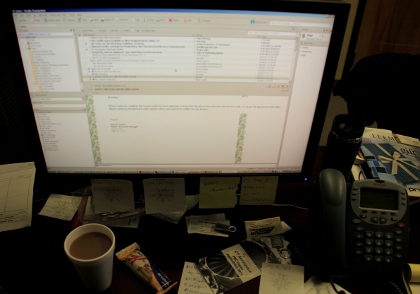
8:00 am: Arrive at the office and grab some coffee and a granola bar to be consumed while checking and answering my e-mail.

Email, Coffee and Granola Bar at 8:00 am

9:00 am: Go through the different magazines for the month and verify our ads were placed and run correctly. After verification, compare invoice information to the Media Plan to ensure accuracy. Approve the invoices and deliver the invoices to the Accounting Department for payment.

Verifying ad placements in various publications

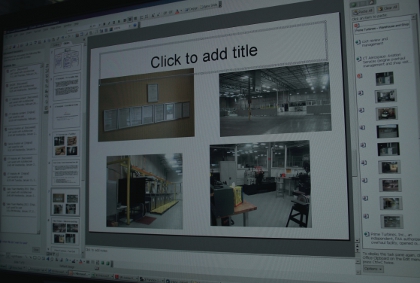
10:30 am: Continue work on a PowerPoint Presentation for the Sales Team.

Creating the sales presentation in PowerPoint

11:00 am: Realize I don’t have all the pictures that I need for the sales presentation, so I head out for a mini photo-shoot! (Logos have been intentionally blurred)

Company logo for sales team presentation

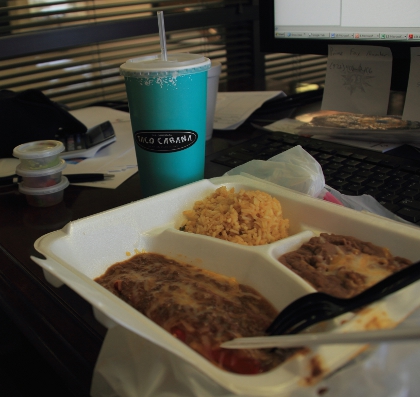
12:00 pm: Finished the photo shoot and picked up a super healthy and nutritious lunch from Taco Cabana, minus the healthy and nutritious part! Checked to see if my grades were posted yet while enjoying my enchiladas… STILL no grades posted.

Delicious enchiladas from Taco Cabana!

1:00 pm: Our tabletop booth was delivered, so I can check the new graphics we just received! This booth will be sent to a tradeshow in about one month, so I’m hoping the graphics are perfect (just as they were in the proof I verified a month ago).

Tabletop Booth

1:45 pm: Graphics are hung, and they look great! One of the magnets on the booth hardware isn’t sticking very well, so I’ve got to ask the manufacturer about replacing it. (Logos have been intentionally blurred)

Booth graphics!

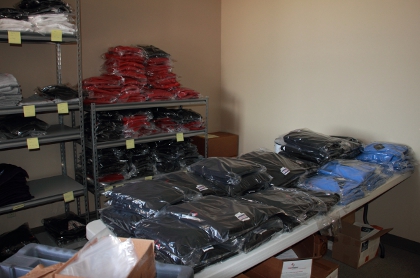
2:00 pm: Unpacking a few shipments of company promotional items. I’m in charge of the promotional room, so it’s like Christmas every few weeks in my office!

Organizing the promotional room

3:00 pm: Pulling pricing for more promotional items, it’s an on-going process!

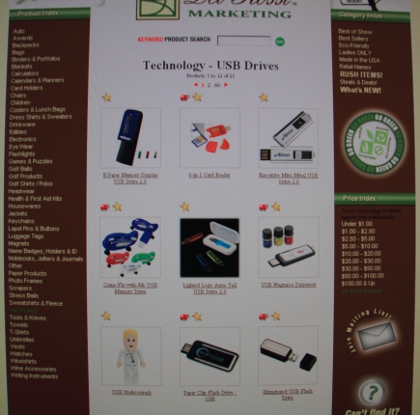
Checking quotes for promotional pricing

3:30 pm – 5:00 pm: Edit the pictures from the mini photo-shoot, answer more e-mail, accept more packages, then head home!

My schedule is never the same from day to day, and it’s always a balancing act! It’s also pretty cyclical, this week was verifying and unpacking all the orders, which means that a few weeks prior it was designing and proofing everything. The most challenging aspects of my job are keeping the priorities straight, and managing the relationships with our vendors and suppliers. I enjoy the fast pace and variety of projects in my position as a Marketing Coordinator.